.IMG9856-724b30749ea81fb91b6a85e9c27bda33d58ed084ace1ce4352a25e6cb70ab100.jpg)
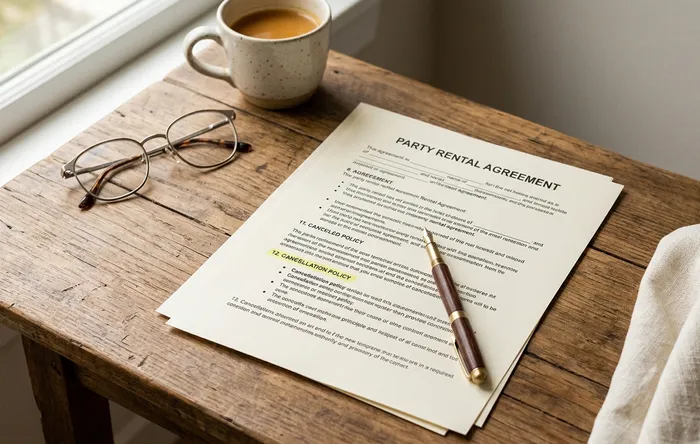
Nobody reads the rental agreement. You get a quote, the number looks fine, you sign the thing on your phone in a parking lot, and you move on to the seating chart.
Then the final invoice arrives with a cleaning fee, a labor charge, and a line item for eleven linens.
None of that is a scam. It's all in the contract you signed. The problem is that party rental agreements are written in an industry dialect where common words mean specific things — "delivery" doesn't mean what you think, and a "damage waiver" is emphatically not insurance. Here's the translation.
The one-line version: delivery is not setup, the damage waiver doesn't cover theft or negligence, weather is almost never a refund, and you're liable for the equipment from the moment it hits your driveway until the moment it's back on the truck.
(This is general industry context, not legal advice — your contract is the contract, and it governs. Read yours.)
"Delivery" Does Not Mean Setup
This is the single most common surprise on a party rental invoice.
For most companies, delivery means the truck brings your order to one accessible point and leaves it there. Stacked chairs, folded tables, boxed linens, sitting in your driveway or at the edge of your lawn. That's the delivery you paid for.
Setup — carrying each item to its position, unfolding it, placing it, laying linens — is a separate line item. So is breakdown. Assume both are extra until a human tells you otherwise in writing.
Related traps in the same clause:
- The delivery window is not an appointment. "Between 8 and 2" is standard. If you need the truck at 9:00 sharp, that's a timed delivery and it costs more. Book it if your day depends on it.
- After-hours and same-day pickup cost extra. So does Sunday.
- Site access is your warranty, not theirs. Most contracts contain a clause where you certify the site is accessible. If the truck can't get down the driveway, or the gate is too narrow, or there are stairs nobody mentioned, the crew hand-carries — and bills the labor. Measure your access points and tell them the real numbers before you sign.
The Damage Waiver Is Not Insurance
Read this section twice. It's the biggest misconception in the industry.
Most rental companies offer — or automatically add — a damage waiver, often somewhere around 10% of your rental subtotal. It sounds like insurance. Customers treat it like insurance. It is not insurance.
A damage waiver is a limited contractual agreement in which the company agrees not to pursue you for accidental damage to their equipment. That's it. It is narrow, and the exclusions are where the money is.
What a damage waiver typically does NOT cover:
| Excluded | Why it matters |
|---|---|
| Theft or "mysterious disappearance" | Chairs left in the yard overnight. Linens that just… go. You pay. |
| Negligence or misuse | Standing on tables, dragging chairs across concrete, overloading a table. |
| Weather damage | Wind takes a tent, rain ruins linens — often excluded. |
| Mildew on linens | The single most common linen charge. See below. |
| Burns, wax, and ink | Candles and Sharpies destroy more linens than anything else. |
| Missing items | A shortage on the return count is a purchase, not a damage claim. |
So the waiver covers the wine glass someone knocked off a table. It does not cover the ten chairs that walked off your lawn at 2am. Ask your rental company for the exclusions list specifically — not the waiver description, the exclusions. And check whether your homeowner's policy or a one-day event policy covers the gap, because the waiver won't.
You Own the Risk From Drop-Off to Pickup
Here's the clause people find genuinely shocking: your liability period runs from delivery to pickup, not from the start of your party to the end of it.
If the truck drops on Friday and picks up Monday, you are responsible for that equipment all weekend — including two nights when it's sitting in an unsecured yard and you're asleep. Theft during that window is on you, and the damage waiver almost certainly excludes it.
Practical response: know your actual delivery and pickup times, not just your event time. If there's an overnight gap, either secure the equipment (garage, locked gate, cover) or pay for tighter delivery windows. The math often favors the tighter window.
The Return Condition Clause Is Where the Labor Fees Live
You're not just returning the items. You're returning them in a specified condition, in a specified place. Miss it and there's a fee, because the crew has to do the work you didn't.
Typical requirements:
- Chairs stacked the way they were delivered, in stacks of the specified count
- Tables folded and stacked
- Everything staged at the original drop point — not scattered around the yard where it was used
- Linens dry, shaken free of food, and in the provided hamper — not in a trash bag, not in a wet pile
- Dishware food-free (many companies say scraped, not washed — but confirm, because some don't)
- Nothing left in or under anything — the crew is loading, not sorting
The linen rules deserve their own paragraph
Linens generate more surprise charges than any other category, and it's always the same three things:
- Wet linens mildew. A damp linen sealed in a bag on Saturday night is a stained, unusable linen by Monday morning. Mildew is usually an outright replacement charge, and it's usually excluded from the damage waiver. Let them air out. Never bag them wet.
- Wax. Candles on rented linens is a coin flip. If you're using open flame, use hurricanes or votives with real containment.
- Burns and ink. Sterno, cigarettes, and the pen at the guest book table.
Get the per-item replacement cost in writing before your event. It's a number the company knows instantly and will tell you if you ask. It's also the number that turns "eh, it'll be fine" into "let's put the linens on the porch to dry."
Weather Is Almost Never a Refund
The clause people assume protects them usually protects the rental company.
Most party rental agreements do not offer refunds for rain. Once the equipment is loaded, dispatched, or installed, you generally owe for it regardless of whether your event happened. A cancelled party is your problem; the truck still rolled.
Two specific things to understand:
- "Act of God" / force majeure clauses. These almost always excuse the company from performing — they don't obligate them to refund you. Read the direction that clause runs.
- Tent wind thresholds. Tent companies have wind speed limits at which they will not install, or at which an installed tent must be evacuated. Your event can be shut down by a number on a weather app, and you will still be billed. This isn't the company being difficult — tents become airborne and people die. But it's your risk, financially.
If weather is a real exposure for you, ask two questions before you book: what is your rain policy in writing? and what's the latest I can add a tent? The second question is often the more useful one.
Cancellation and Changes: Know Your Two Deadlines
Two separate clocks, and people confuse them.
Cancellation is usually tiered: your deposit is non-refundable from the moment you sign, and then the refundable percentage steps down as the date approaches — full refund minus deposit at 30 days, partial at 14, nothing at 72 hours, or some variation. Find your tiers.
Reduction is different and more forgiving. Most companies let you reduce an order — drop 20 chairs when RSVPs come in low — up to some deadline, often within a capped percentage of the original. This is why the standard advice is to book high and trim down: adding to an order late means whatever's left in inventory, but reducing is usually a phone call.
Ask specifically: how late can I reduce, and by how much?
The Fees That Aren't in the Quote
Quotes show the equipment. Invoices show everything. Ask which of these apply:
- Delivery fee — often mileage-based, sometimes zoned
- Setup and breakdown labor — separate from delivery
- Timed / narrow delivery window surcharge
- After-hours, weekend, or holiday surcharge
- Damage waiver — often auto-added; ask if it's optional and what it excludes
- Cleaning fee — for dishware or equipment returned outside spec
- Restocking fee — for items returned unstaged or unsorted
- Fuel — if you rented a generator, ask who fuels it and at what rate
- Stair, long-carry, or difficult-access labor
- Sales tax and any environmental/recovery surcharge
- Permit fees — for tents, in some jurisdictions
Then ask the only question that cuts through all of it: "Can you send me an all-in quote with every fee included, assuming nothing goes wrong?" A good company will. A company that won't has told you something useful.
The Clause About Injuries
Buried near the bottom of most agreements is an indemnification or hold harmless clause: you agree that once the equipment is in your possession, injuries arising from its use are your responsibility, not theirs.
For chairs and tables this is mostly theoretical. For bounce houses, inflatables, dance floors, staging, and heaters it is not theoretical at all, and it's worth knowing you're the one holding that bag. If you're renting anything in that category, this is the moment to look into a one-day event liability policy. They're typically inexpensive relative to what they cover, and some venues and municipalities require one anyway.
Frequently Asked Questions
Does a party rental damage waiver cover theft? Usually not. Damage waivers typically cover accidental damage only and commonly exclude theft, mysterious disappearance, negligence, weather damage, and mildew. Ask for the written exclusions list, not the summary.
Do party rental companies refund for rain? Generally no. Most contracts obligate you once the equipment is dispatched or installed, and force majeure clauses usually excuse the company from performing rather than requiring a refund to you. Ask for the rain policy in writing before you book.
Is setup included in party rental delivery? Usually not. For most companies, delivery means dropping the order at one accessible point. Placing chairs, laying linens, and breakdown are separate charges. Confirm in writing.
What happens if I return linens wet? They mildew, and you're typically charged full replacement cost — and it's often excluded from the damage waiver. Let linens air-dry before returning them, and never seal them damp in a bag.
Am I responsible if rentals are stolen overnight? Almost certainly yes. Your liability period runs from delivery to pickup, which usually includes any overnight the equipment spends at your site. Theft is generally excluded from damage waivers.
Can I reduce my rental order after booking? Usually, up to a deadline and within a capped percentage. Reducing is far easier than adding, which is why booking high and trimming down is standard practice. Ask for your specific reduction deadline.